

Since August 12, 2026, the EU Packaging Regulation PPWR has been directly applicable in all EU countries. It applies to every Swiss company whose packaged goods end up in the EU – whether directly or through a customer. A crucial question that many underestimate: Is your product sold under your own brand or under the brand of your customer?
At a glance
Status: In force and applicable since 12 August 2026 – Regulation (EU) 2025/40- since 12.08.2026Limit values for PFAS in food packaging and for heavy metals; technical documentation and EU declaration of conformity
- from 12.08.2028 (earliest)harmonized labeling of the material composition
- from 01.01.2030 (earliest)Recycling ability (levels A–C), minimum recycled content for plastics, minimum empty space 50 %
- from 01.01.2038only recycling capability of levels A or B
«As soon as possible»: Several deadlines are being pushed back until the EU Commission has adopted the necessary implementing regulations. The labeling requirements were due on August 12, 2026, and have not yet been met.
Status: September 27, 2026

What it's about
The PPWR replaces the current EU Packaging Directive from 1994. Unlike a directive, a regulation does not have to be transposed into national law first – it applies equally in all 27 Member States. It covers all packaging: sales, return and transport packaging, as well as shipping cartons in online trade.
The goal is to produce packaging that is less and better usable. To achieve this, the regulation focuses on design (recyclability, recyclate content, no unnecessary empty space), materials (PFAS, heavy metals), and information (labeling, documentation).
Who is affected – and in what role
For PPWR, where the packaging is placed on the market does not matter; the place where the company is headquartered does. The obligations you have as a Swiss company depend on your role:
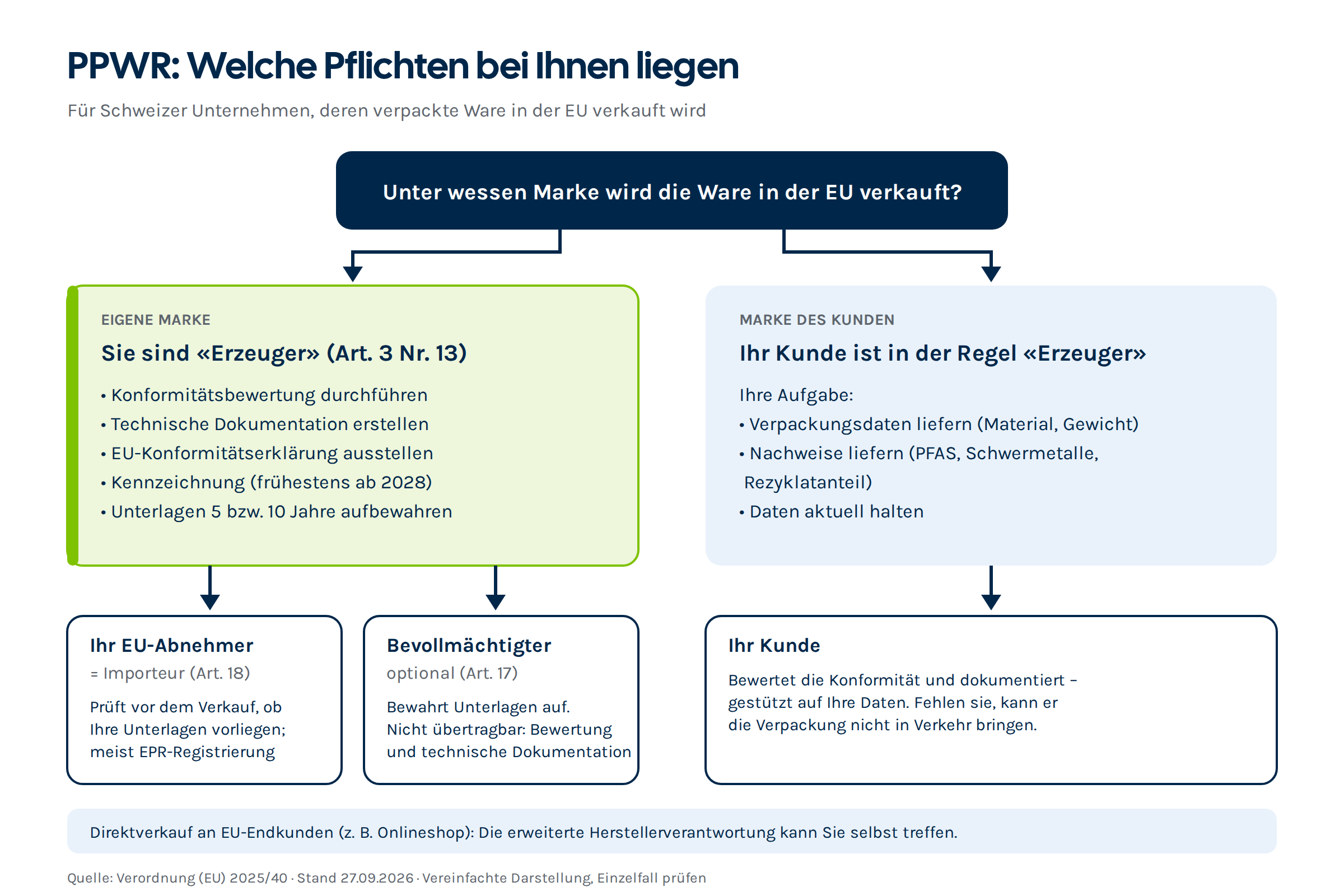
- Products under your own brand: Then, after the PPWR, you are the «producer» – even if you are based in Switzerland (Art. 3 No. 13). You must perform the conformity assessment, create the technical documentation, and issue the EU declaration of conformity. Your EU customer is the importer and must verify that these documents are available before placing the product on the market (Art. 18).
- Goods under your customer's brand or components that your customer processes further: In that case, the producer obligations usually lie with your customer. However, they need your data and proof for this.
Important: You can indeed appoint an authorized representative in the EU. However, you cannot explicitly transfer the conformity assessment and the technical documentation to them (Article 17). This work remains with the producer.
In addition, there is the extended manufacturer responsibility – the obligation to register in each target country and pay fees for collection and recycling. This usually falls on the person who first provides the packaging in the respective EU country, which is usually your importer. If you sell directly to end customers in the EU, for example through an online store, this may also fall to you.
The challenge for SMEs
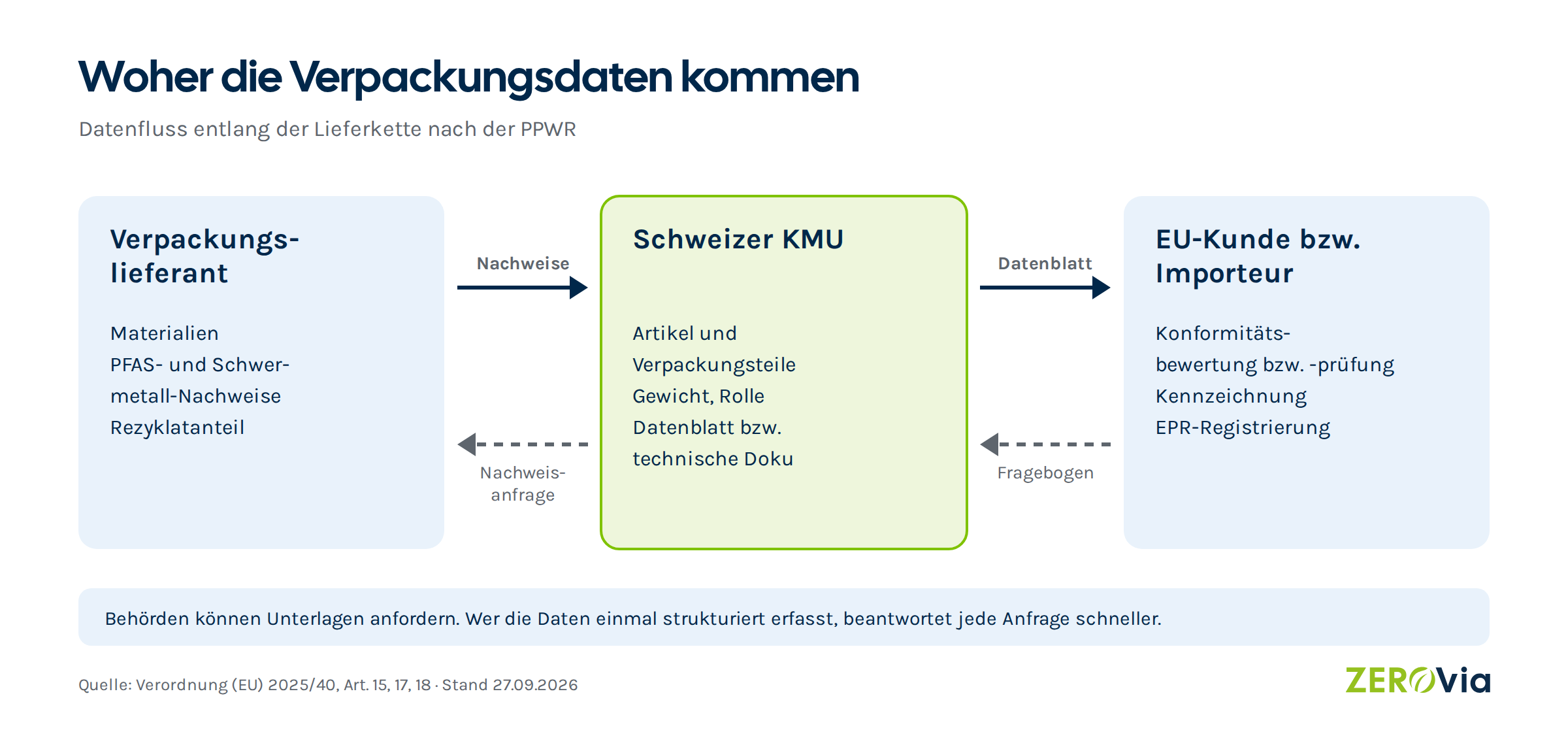
The PPWR requires proof of things that many SMEs do not have in-house: what materials are the cardboard, foil, and label made of? Does the coating contain PFAS? What is the recyclate content? These details are available from the packaging supplier – often even from its upstream suppliers.
At the same time, the first questionnaires are arriving from EU customers who need to secure their own conformity assessment. And authorities can request documents – for example, an authorized person must submit them within ten days (Article 17). Those who then start looking for them have a problem.
This coincides with our Study 202657 % of the respondents cite a lack of transparency in the supply chain as the biggest obstacle to ESG management. (n = 74, not representative; 30 % of the responses came from companies with over 5’000 employees.)
The opportunity
EU customers will choose their suppliers based on who provides the required packaging data in full and without questions. Those who can do so will remain in the product range. Those who cannot will become a risk to the customer. Although many deadlines are not until 2028 and 2030 – new packaging needs time to be developed, and contracts are being negotiated today.
A look beyond the border: the new Swiss packaging regulation
Switzerland is also following suit: On June 24, 2026, the Federal Council adopted a new packaging regulation that will take effect on January 1, 2027; individual provisions will come into effect in stages until 2032. It regulates all packaging for the first time and replaces the 2000 regulation on beverage packaging. It sets requirements for placing products on the market, regulates take-back and disposal, and sets recycling targets: plastic packaging is to be recycled at least 55 percent and beverage cartons at least 70 percent. According to the Federal Office for the Environment, this brings Switzerland closer to the EU – it is not a prerequisite for adopting the PPWR. Those who supply to both markets should keep both requirements in mind.
PPWR and Digital Product Pass: related, but not the same
PPWR and the Digital Product Pass are often mentioned in the same breath. However, they are two different regulations: The PPWR regulates packaging, while the Product Pass is based on the Ecodesign Regulation (ESPR) and concerns the product itself. Currently, there is no requirement for a product pass for packaging.
The data includes the following information: materials, weight, recyclability, recyclate content, and materials. And the technology includes a unique identifier and a data carrier such as a QR code. Anyone who structures their packaging data today in a structured way will answer today’s PPWR requests – and have a foundation for tomorrow’s product passport. More about this in our article on the Digital Product Passport (in preparation).
Prepared in five steps

- Clarifying roles – per market and product: Own brand or customer brand? Delivery to an importer or directly to end customers?
- Packaging to be included: Which articles are going into the EU, and what packaging components are they made of (material, weight)?
- Obtain proof: Request information from the packaging supplier regarding PFAS, heavy metals, and recycled content – in bulk, not per customer request.
- Documenting and providing: As a manufacturer, create technical documentation and a declaration of conformity; as a supplier, provide a packaging data sheet for your customers.
- Follow deadlines: Plan for the labeling (from 2028) and recyclability (from 2030) early in new packaging.
Checklist for getting started
- List of items that are delivered to the EU
- Role clarified for each article (own brand or customer brand)
- Packaging components with material and weight are recorded
- PFAS detection for packaging with food contact available
- Packaging suppliers asked for recycled content and recyclability
- Responsibility is determined internally and documents can be found within ten days
How ZEROvia supports
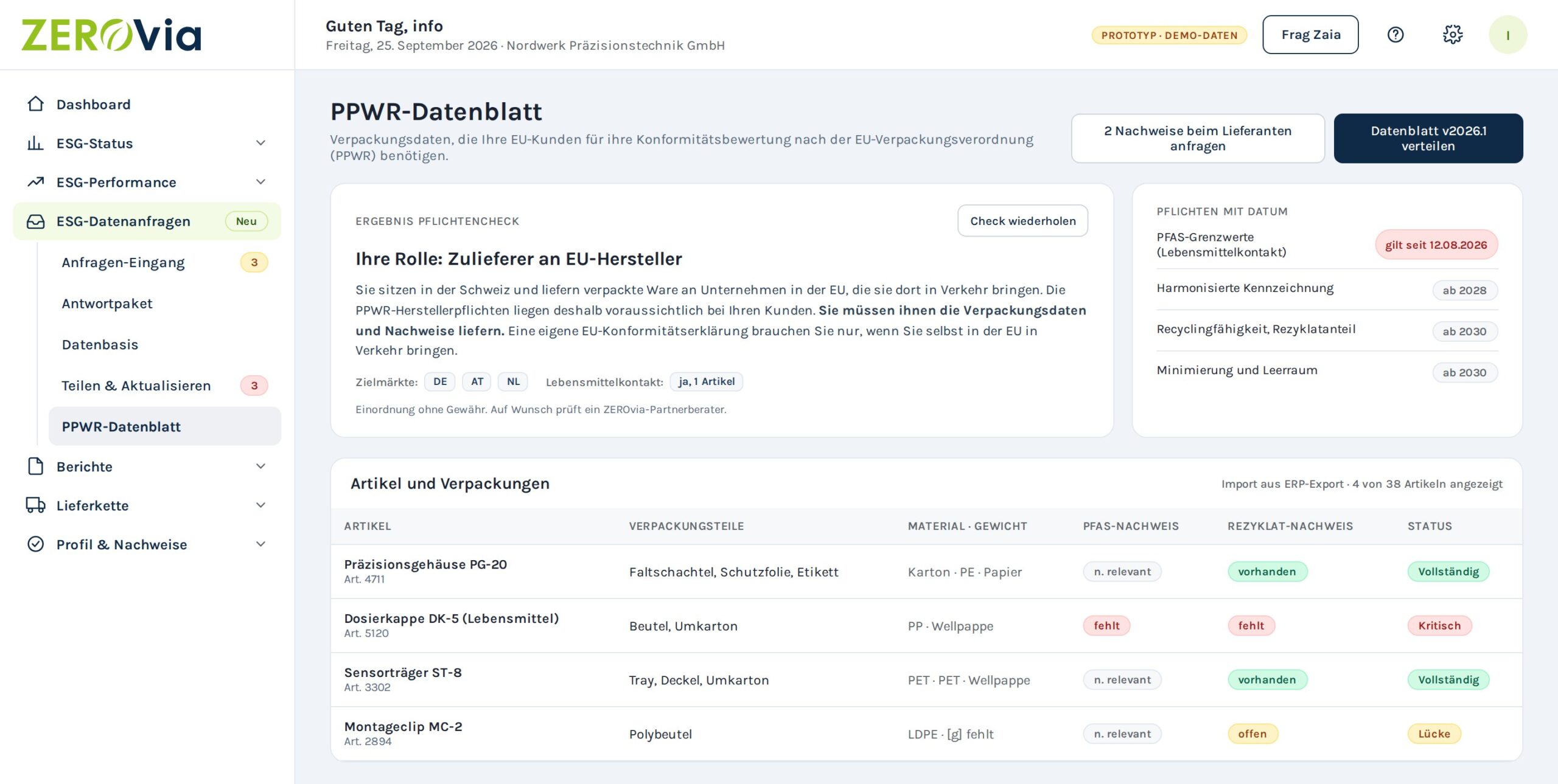
In preparation: the PPWR data sheet (expected in 2027). Capture packaging data per item, even from an ERP export. Request missing proofs from the packaging supplier in one place. Version the data sheet for your EU customers and automatically update it when changes occur. A role check shows which duties you have.
Available today For your other sustainability data: from the ESG Quick Check to the VSME report, the AI-powered response to customer inquiries with your own data and document templates for missing guidelines.
Do you already have PPWR requests from EU customers on the table? Contact us.
Next steps
Download the PPWR fact sheet (PDF)
PDF, 1 page · all the facts at a glance
- Arrange a meeting – we will show you the progress of the development
- All articles on regulation – for example NUFG draft: What SMEs as suppliers should know now
Sources
- EUR-Lex: Regulation (EU) 2025/40 on packaging and packaging waste, 19 December 2024 (Art. 3, 5, 6, 7, 12, 17, 18, 24, 71)
- BDO Switzerland: PPWR – new EU rules for packaging, Retrieved on September 27, 2026
- Härting Rechtsanwälte: EU packaging regulation for Swiss retailers, Retrieved on September 27, 2026
- WKO: EU Packaging Regulation: PPWR obligations from 2026, Retrieved on September 27, 2026
- Circulaya (ppwr.ch): What the PPWR means for SMEs from an EU third country, September 16, 2026
- Federal Council: Media release regarding the new packaging regulation, June 24, 2026
- Fedlex: Packaging Regulation (VerpV), SR 814.621, from June 24, 2026
- take-e-way: VerpV and PPWR: New obligations for the Swiss market, September 22, 2026
- BAFU: Circulable packaging, September 1, 2026
- CIRPASS2 / Circular Analytics: ESPR and PPWR, August 27, 2024
- ZEROvia: Study 2026, September 2026
This article provides guidance and is not intended to replace legal advice. Last updated: September 27, 2026.