

Since September 27, 2026, the EmpCo directive has been in effect throughout the EU. «Environmentally friendly», «climate neutral» or a private sustainability label – such statements are only allowed to be used in front of consumers if they are substantiated. This also applies to Swiss companies. And it also applies to suppliers who don’t even advertise: because the evidence is often found in their supply chain.
At a glance
Status: In force and to apply from 27 September 2026 – Directive (EU) 2024/825- WhoCompanies that make environmental claims to consumers in the EU – regardless of their headquarters
- WhatNew prohibitions for general environmental claims, own seals, climate neutrality through compensation, promises for the future without a plan
- SwitzerlandFrom January 1, 2025, climate claims must be objectively and verifiable in accordance with the UWG – also in front of business customers.
Status: September 27, 2026

What will change with EmpCo
The EmpCo Directive («Empowering Consumers for the Green Transition») supplements the EU Directive on Unfair Commercial Practices. It has been implemented into national law – in Germany, for example, in the Act against Unfair Competition. At its core is a list of practices that will in future be considered unfair in any case (Annex I):
- General environmental statements without proof How «environmentally friendly», «green» or «sustainable» if the company cannot substantiate the underlying excellent environmental performance (No. 4a)
- Our own sustainability seals, which are not based on a certification system or not established by a government (No. 2a)
- Statements about the entire product or company, if they concern only a partial aspect (No. 4b)
- Climate neutrality through compensation: Statements that a product is climate neutral, CO₂-reduced or climate positive thanks to compensation (No. 4c)
- Naturalness as an advantage: represent legal obligations as a special feature of their own offering (No. 10a)
In addition, anyone who promises future environmental performance – such as «net-zero by 2035» – needs a detailed, realistic implementation plan with measurable targets, which is regularly reviewed by independent experts (Article 6(2)(d)). The directive also regulates information regarding durability, reparability, and software updates.
When EmpCo affects Swiss companies
What matters is who reaches the audience; not where the company is located. Anyone who sells to consumers in the EU through an online store, runs campaigns in EU markets, or delivers packaging and advertising texts to retailers in the EU is included. This includes packaging, product names, websites, social media, and even sustainability reports, insofar as they are directed at consumers.
The consequences of a violation range from failure to comply to new packaging to fines; according to the BDO, up to 4 % % of annual turnover may be at risk. Individual states, such as Germany, have transitional rules for goods that have already been placed on the market before the deadline.
And in Switzerland? What the UWG requires
Even without EU affiliation, a proof of residence is already required in Switzerland. As of January 1, 2025, the following applies: Federal Act against Unfair Competition (UWG) Unfair is anyone who «makes statements about themselves, their goods, works or services regarding the climate burden caused, which cannot be substantiated by objective and verifiable facts» (Art. 3(1)(x) UWG).
What that means in practice:
- Climate statements about products and about the company itself are included – for example, «climate neutral», «CO₂ reduced» or «net-zero companies».
- Not only towards consumers: The UWG covers any behavior that affects the relationship between competitors or between providers and purchasers (Article 2 UWG) – in principle, this also includes statements made to business customers, for example in offers or on the website.
- Evidence must be available: The statement must be based on objective and verifiable foundations. Furthermore, a court may require that advertisers prove the accuracy of their factual claims (Art. 13a UWG).
The difference with the EU: The Swiss rule is more restrictive because it applies to climate statements. The EmpCo directive covers environmental and sustainability statements more broadly and with specific prohibitions, but it only applies to consumers. Therefore, anyone who communicates in both markets should adhere to both standards.
The duty to provide proof does not end at the trademark
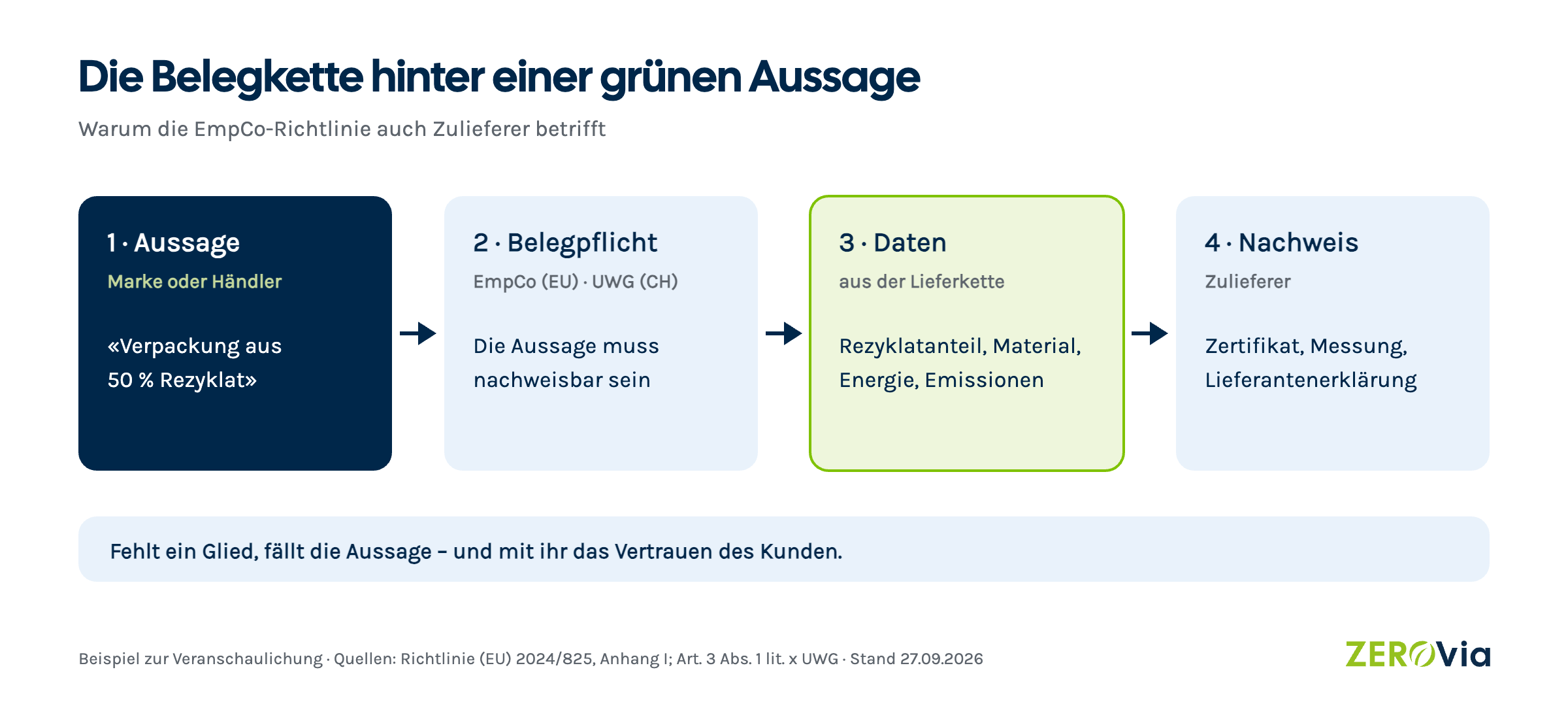
The EmpCo directive is consumer law. At first glance, it affects brands and retailers, not suppliers. I think that’s a misinterpretation.
Take a statement like «packaging made from 50 % recycled materials» or «produced with 40 percent % less CO₂.» The brand that labels its product must be able to substantiate it. But it rarely has the data itself. It usually has to rely on the packaging supplier, the component manufacturer, or the logistics provider. Starting today, therefore, a green claim is only as good as the data that comes from the supply chain.
This matches what we have in our Study 2026 57 % of the respondents cited a lack of transparency in the supply chain as the biggest obstacle to ESG management. Only 24 % have complete transparency with their direct suppliers; for those further down the supply chain, it is 2 . %. (n = 74, not representative; 30 % of the responses came from companies with over 5’000 employees.)
This is exactly where I see the opportunity for SMEs. Anyone who can structure their sustainability data and provide evidence as a supplier makes it easy for their customers to make legally sound statements. Anyone who cannot do that becomes a risk to their customers’ communication. That’s why we built ZEROvia from the beginning so that the data stands behind every statement – not the other way around.
What you should do now
- Gathering statements: All environmental and sustainability statements are included on packaging, the website, social media, in quotes and reports.
- Check who is reading them: Is the statement directed at consumers in the EU, Switzerland, or business customers?
- Assigning evidence: For each statement, record the data and evidence on which it is based – and where these are lacking.
- Delete or refine: Replace general terms with specific, substantiated information; verify proprietary seals and compensation-based climate neutrality.
- Data base security: Track missing data from suppliers and regularly update it – and be prepared as a supplier if your customers ask.
How ZEROvia supports
ZEROvia does not replace the legal review of your advertising statements. But ZEROvia creates the data base on which verifiable statements are based:
- Managed sustainability reporting From the ESG Quick Check to the VSME report – with data that you can easily capture
- Respond to customer inquiries: Respond to inquiries in any format using AI, based on your own data, and verify them before shipping
- Closing documentation gaps with document templates directly in the platform
- ESG profile: You decide which data is visible – instead of using keywords, you show metrics
- Supplier screening: Own suppliers to be assessed based on sustainability criteria using AI
Next steps
- Start ESG Quick Check – see in just a few minutes which data you already have
- Arrange a meeting
- All articles on regulation
Sources
- EUR-Lex: Directive (EU) 2024/825 (EmpCo), 28 February 2024 (Art. 1 No. 2 and 3 with Annex I No. 2a, 4a, 4b, 4c, 10a; Art. 6(2)(d) of Directive 2005/29/EC n.f.)
- BDO Switzerland: EmpCo 2026: What Swiss companies must now check, Retrieved on September 27, 2026
- öbu: Green Claims under new rules, September 18, 2026
- Fedlex: Federal Act against Unfair Competition (UWG), SR 241, As of January 1, 2025 (Art. 2, Art. 3, paragraph 1, letter x, Art. 13a)
- MME: Even «circular claims» require reliable evidence, September 22, 2026
- PwC Germany: EmpCo directive, Retrieved on September 27, 2026
- myclimate: What is the EmpCo Directive?, Retrieved on September 27, 2026
- ClimatePartner: Empowering Consumers Directive and Switzerland tightens regulations for environmental claims, Retrieved on September 27, 2026
- FSC Switzerland: EmpCo – what the new EU directive means, Retrieved on September 27, 2026
- Noerr: EmpCo directive from 27.09.2026: Last-minute arrangement for obsolete stocks, Retrieved on September 27, 2026
- ZEROvia: Study 2026, September 2026
This article provides guidance and is not intended to replace legal advice. Last updated: September 27, 2026.