ZEROvia · Guide for Swiss SMEs

ESG Reporting Tool for SMEs Switzerland — What You Really Need in 2026

Swiss SMEs are facing increasing ESG pressure from banks, insurance companies, and large clients. This guide shows what requirements an ESG reporting tool must meet today and which selection criteria really matter — focused on VSME, the VS standard expected to apply from July 2026 onwards, bankability, and Swiss data hosting.

At a glance

  • VSME is the voluntary EU standard that is effectively becoming the norm for Swiss SMEs — supplemented, likely starting in July 2026, by the EU Commission's building-block VS standard based upon it
  • Bankability means: standardized data points on emissions, personnel, and governance with verifiable evidence
  • Swiss data storage is a strict selection filter for many SMEs — due to FADP and customer requirements
  • Enterprise tools like Workiva or Sphera are unsuitable for SMEs — too expensive, too complex
  • Rating tools like esg2go deliver a label, but no data platform — often too thin for bank discussions

Content

Why Swiss SMEs now need an ESG reporting tool

Three triggers will converge in 2026 and hit Swiss SMEs simultaneously.

Banks request ESG data in credit negotiations. UBS, Raiffeisen, Zürcher Kantonalbank and others have introduced ESG screening questionnaires for corporate clients. Those who cannot provide an answer may, in case of doubt, receive less favorable terms or have to deliver ad hoc — under time pressure and without a proper audit trail.

Large customers are pulling their supply chain into CSRD and CSDDD. If a Swiss SME works as a supplier to a German DAX corporation or a French CAC-40 company, the questionnaire arrives automatically—often via EcoVadis, IntegrityNext, or directly from procurement. A prepared ESG profile cuts the effort per request in half.

Insurers examine ESG risks when issuing policies. Above all, property, liability, and D&O insurers are increasingly demanding ESG disclosures upon renewal. Those who fail to deliver pay risk surcharges or cannot find a policy.

The combination of these three triggers makes structured ESG reporting mandatory for Swiss SMEs in 2026 — even if there is no formal CSRD obligation.

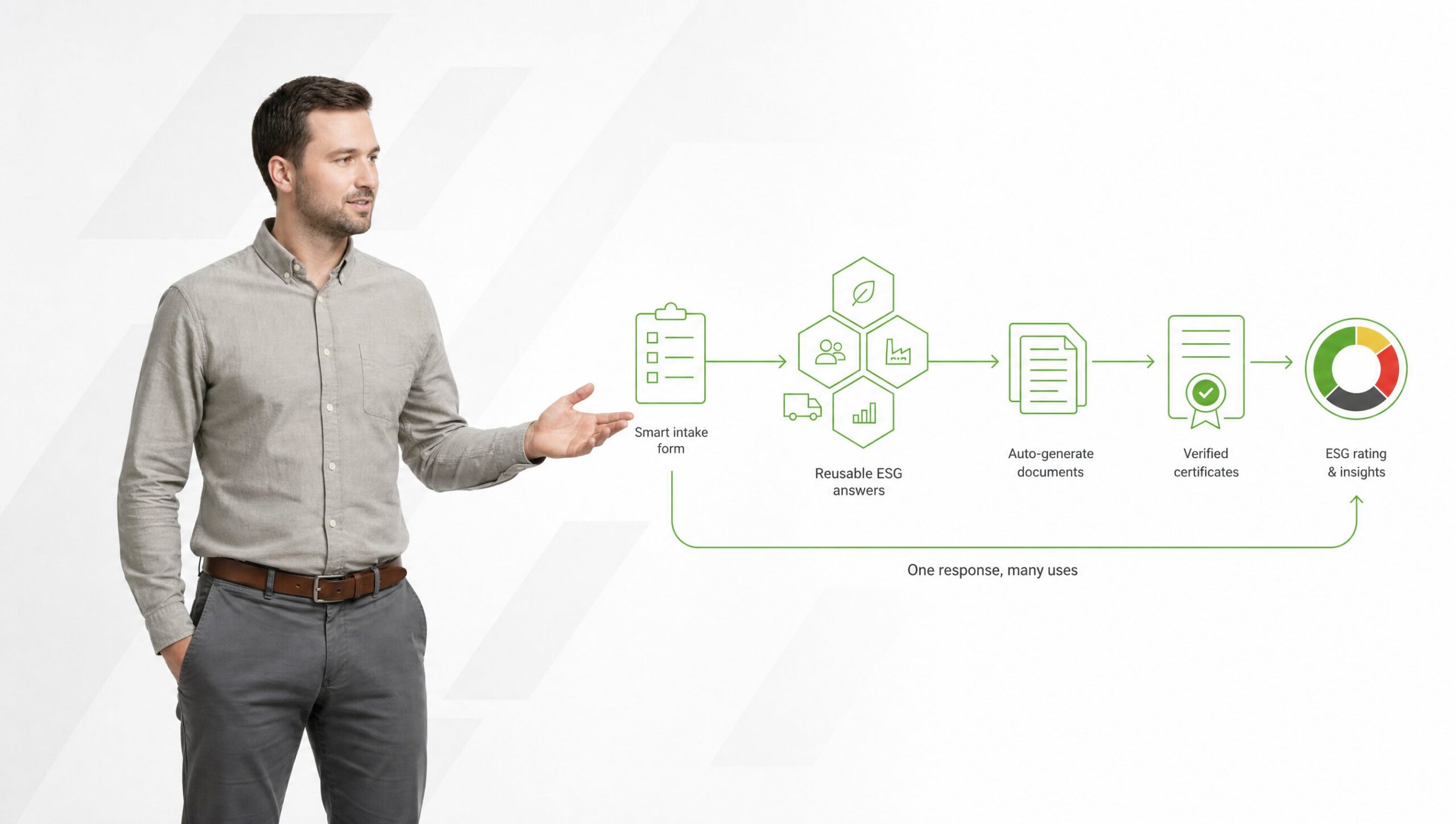
The 7 selection criteria for an SME-friendly ESG reporting tool

These criteria can be reviewed in a 30-minute workshop before any tool decision.

1. VSME-Native

The tool directly reflects the Voluntary Sustainability Reporting Standard for SMEs — not as a retrospective mapping from CSRD.

2. Swiss data hosting

Data is located in Switzerland, FADP-compliant, without US cloud transfer.

3. Bankable

Standardized output with data points that banks require in credit discussions — CO2, energy, personnel, governance.

4. Evidence Linkage

Each data point links to a verifiable source—invoice, certificate, document.

5. Controlled Visibility

You decide per data point: public, controlled shareable, internal. No black-box score.

6. AI Support

AI extracts data from documents, suggests values, highlights gaps. Human makes the final decision.

7. Modular extensibility

Start with ESG Quick Check, later VSME Basic, then supplier screening. No big-bang rollout.

If a tool fails to meet three or more of these criteria, it is not the right choice for a Swiss SME in 2026 — regardless of the marketing.

What VSME and the VS standard concretely mean

VSME stands for Voluntary Sustainability Reporting Standard for SMEs and was developed by EFRAG, the European Financial Reporting Advisory Group. It is the simplified offshoot of CSRD/ESRS for companies with fewer than 250 employees.

VSME has two modules

  • VSME Basic: Entry-level version with core data points — around 50 data points. Suitable for SMEs reporting for the first time.
  • VSME Comprehensive: Expansion with strategy, goals, measures, and selected key performance indicators — about 100 additional data points. Suitable for SMEs with bank, insurance, or supplier inquiries.

The important thing about the VSME principle

VSME follows the „if applicable» principleYou report only data points that are relevant to your company. No production with high water consumption? Then the water module is omitted. Fewer than 50 employees? Then several social indicators are omitted.

This lean approach is the decisive difference compared to CSRD — and the reason why an SME should not report based on the CSRD standard, but rather on the VSME standard.

New from summer 2026: the VS standard

In May 2026, the European Commission draft the Voluntary Use Sustainability Reporting Standards (VS-Standard) published together with the revised ESRS. The VS standard builds directly on EFRAG's VSME standard, extends its reporting logic beyond SMEs, and positions it as common reference framework for voluntary sustainability reporting outside the scope of the CSRD.

The introduction of the VS standard is closely related to the Value Chain Management the revised CSRD: This mechanism limits the ESG information that large companies subject to reporting requirements may request from smaller suppliers and customers outside the scope of the CSRD. Even though application remains voluntary, the delegated act thereby creates a legal framework, which establishes the VS standard as a reference point for data queries along the value chain.

The most important differences from the VSME standard:

  • Alignment with the simplified ESRSThe VS standard adopts the revised ESRS logic, but retains the two-module structure of the VSME.
  • Clear data point categorizationData points are divided into three classes — necessary, if applicable and voluntary. Only data points classified as necessary fall under the Value Chain Cap.
  • Additional simplifications for micro-enterprisesMicro-SMEs benefit from an additionally reduced dataset.
  • Basic structure remains VSME-compatibleThose who start with VSME today can migrate to the VS standard without interruptions.

Practical consequence for Swiss SMEsFrom July 2026, the VS Standard is expected to become the central language in which large companies subject to the CSRD request ESG data from suppliers and borrowers. Those who set up VSME today are prepared for the VS Standard—the data architecture is the same.

What bankable means in detail

„Bankable is not an official standard, but a pragmatic requirement for data quality. Swiss banks have introduced ESG screening questionnaires over the past 18 months that typically query these data points.

Subject area Typical data points VSME Mapping
Climate CO2 Scope 1, Scope 2 (location- and market-based), Energy Intensity B3, B4
Energy Total consumption, renewable share, heat source B3
Personal Number of employees, gender distribution, fluctuation, workplace accidents B8, B9, B10
Governance Anti-corruption, board diversity, data privacy incidents B11, C9
Supply chain Critical suppliers, country clusters, sustainability audits C1, C7

A bank-compliant tool provides these standardized data points — including the audit trail. A PDF file is no longer sufficient today; banks are increasingly demanding structured data or a machine-readable profile.

4 steps to your first ESG report

This approach works for SMEs with 10 to 1,000 employees — regardless of industry.

1. ESG Quick Check (30 minutes)

Structured self-assessment across all ESG topics. Identifies which VSME modules are relevant for your company and where data gaps exist.

2. Data collection (2 to 3 weeks)

Collect electricity, gas, and fuel bills, personnel data, supplier list, governance documents. AI-supported extraction significantly shortens this step.

3. Generate VSME Basic Report (3 to 5 days)

The tool generates the report from the collected data. You review every value before approval. Receipts are linked to each data point.

4. Publish ESG profile (1 day)

You decide per data point: public, controlled shareable with bank or customer, or purely internal. The machine-readable profile is shared via a stable URL — upon request with an audit trail.

After this initial run, the database is established. Subsequent years typically take only 3 to 5 days of total effort.

How ZEROvia covers the 7 criteria

ZEROvia is an ESG reporting tool developed in Graubünden for Swiss and Austrian SMEs with 10 to 1,000 employees.

  • VSME and VS Standard NativeZEROvia maps VSME Basic and Comprehensive directly — no mapping from CSRD. Expected from July 2026, the EU Voluntary Sustainability Reporting Standard (VS Standard) will complement the VSME standard; ZEROvia automatically migrates the data into the VS categorization (necessary, if applicable, voluntary).
  • Swiss data storageHosted by Infomaniak (Geneva), Swiss data protection law (revFADP), no US CLOUD Act access.
  • BankableStandardized output with all typical banking data points — CO2, energy, personnel, governance, supply chain.
  • Evidence linkingEvery data point with traceable evidence, confidence score, and AI audit trail.
  • Controlled visibilityThree profile types — Self-Declared, Verified by ZEROvia, and Audited (prepared). You decide who sees what and when.
  • AI supportAI extracts from documents, suggests values, highlights gaps. Human decides every approval.
  • ModularStart with ESG Quick Check (free), then VSME Basic, later Comprehensive and Supplier Screening.

ZEROvia is structured as a modular ecosystem. You only pay for what you actively use — and you retain data sovereignty at all times.

More on the methodology: Methodology Overview.
Comparison with other providers: Comparison Overview.

Frequently asked questions

Start ESG Quick Check

30 minutes, free, structured self-assessment covering all VSME topics.

As of June 2026. Methodology, VSME mapping, and VS standard migration are updated with every EFRAG or EU Commission standard change. Last substantive revision by the ZEROvia methodology team on June 26, 2026.
